News & Stories
Press Release
01 September 2026
Writing the Rules for Critical Minerals: CIJ Publishes Toolkit for African Governments
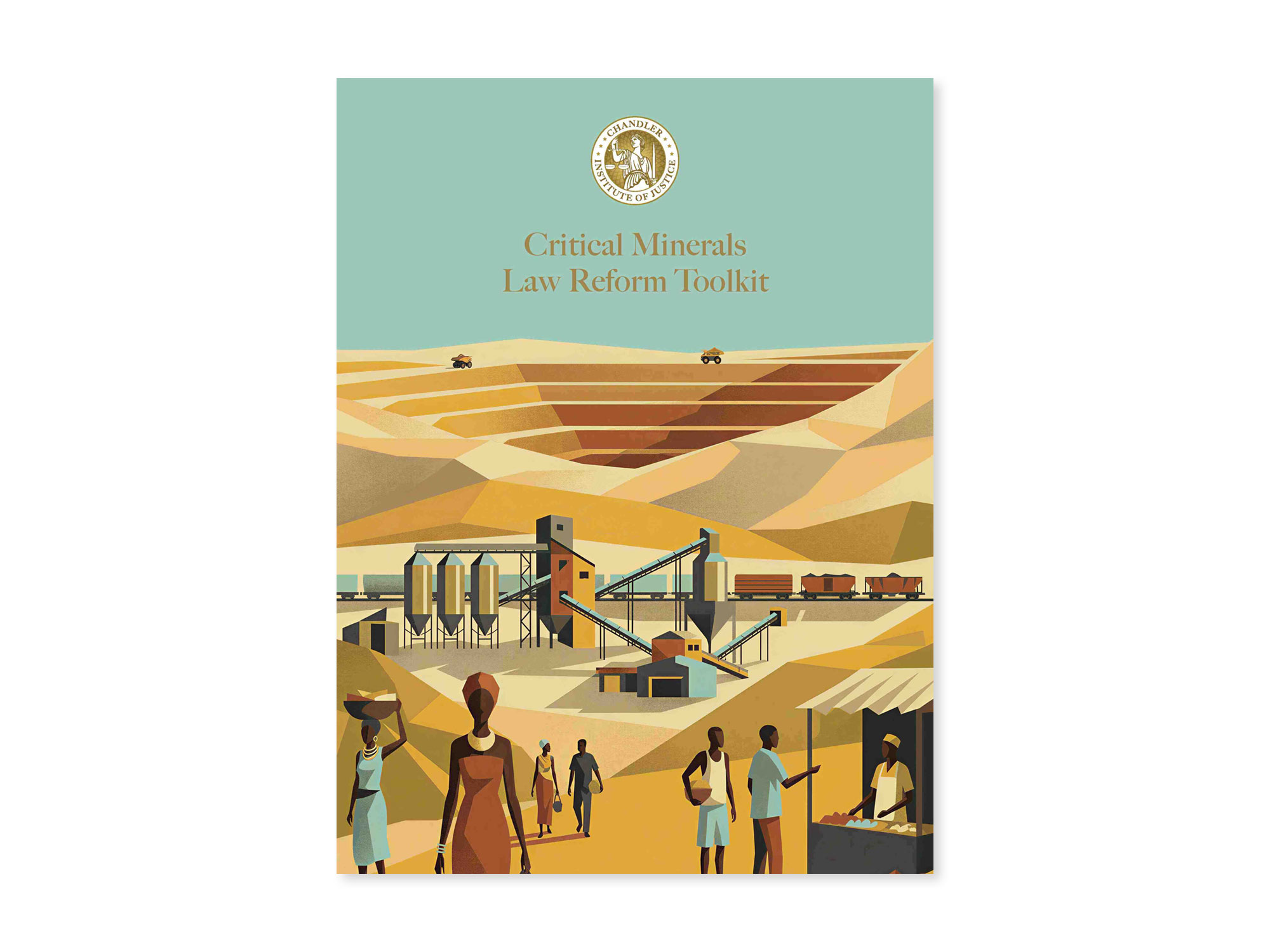
SOUTH AFRICA – The Chandler Institute of Justice (CIJ) has published its Critical Minerals Law Reform Toolkit to help African governments write the rules that turn mineral wealth into lasting national benefit. Written for policymakers, regulators, and negotiators, the Toolkit is now available to download at www.cij.law/knowledge.
Why the Toolkit Matters
Accelerating global demand for critical minerals places Africa at a pivotal moment. The continent holds a significant share of the world’s critical mineral wealth. As Ron Chari, Executive Director, CIJ, writes in the Toolkit’s Foreword, “The continent’s geology is rich, but geology alone does not deliver prosperity. What matters is governance: robust laws, capable institutions, and the capacity to negotiate, regulate, and steward mineral development in the public interest.”
Practical Tools for Every Stage
The Toolkit gives governments practical legal, fiscal, regulatory, and contractual tools to design frameworks, negotiate agreements, and oversee implementation, turning national critical minerals strategies into clear, enforceable action. It builds on existing mining laws, showing how to adapt and supplement them for the critical minerals era in ways that suit national context and capacity, so that governments can secure value while attracting investment.
Its eight chapters cover the key decisions governments face, from promoting local processing and developing shared-use infrastructure to structuring state equity, setting fiscal terms, and embedding sustainability obligations in law. Each provides decision-making tools, such as checklists, decision trees, model clauses, and practice notes, to help governments evaluate priorities and adapt policies over time. Case studies range from Botswana’s negotiated agreements to process more of its diamonds locally to the Lobito Corridor, which links the Copperbelt of the Democratic Republic of the Congo and Zambia to Angola’s port of Lobito and offers scale beyond what any single country could achieve alone.
What Governments Can Do in the Next 12 Months
The final chapter distils eight core design principles and sets out a practical pathway for reform. Within six to 12 months, and where these are not already in place, governments may consider publishing a concise national strategy that defines their critical minerals of interest; clarifying when mineral rights are granted on a first-come, first-served basis, by tender, or through negotiation; and strengthening permitting through process maps, statutory timelines, and transparency measures. Further steps follow over 12 to 24 months and the medium term.
CIJ is grateful to Glen Ireland, whose careful analysis and dedication helped give the Toolkit its clear structure, and to Leezola Zongwe for her contributions. CIJ also thanks the peer reviewers – Otsile Matlou, Scot Anderson, Leon Gerber, Nomsa Mbere, Paula-Ann Novotny, and Ernst Muller – whose feedback made the Toolkit sharper and more practical.
“Used deliberately,” Chari writes, “law can convert resource wealth into national prosperity.”
About Chandler Institute of Justice (CIJ)
Chandler Institute of Justice offers expert advisory services on law reform, delivers specialised legal training programmes, and develops innovative legislative tools and models to support transformative law reform initiatives across Africa. CIJ’s work is anchored on the belief that good laws are not only the cornerstone of just and equitable societies but powerful catalysts for economic prosperity. CIJ’s mission is to partner with African governments to drive impactful, government-led law reforms while building legal knowledge and expertise that foster good governance, sustainable economic growth, and social mobility across the continent.